
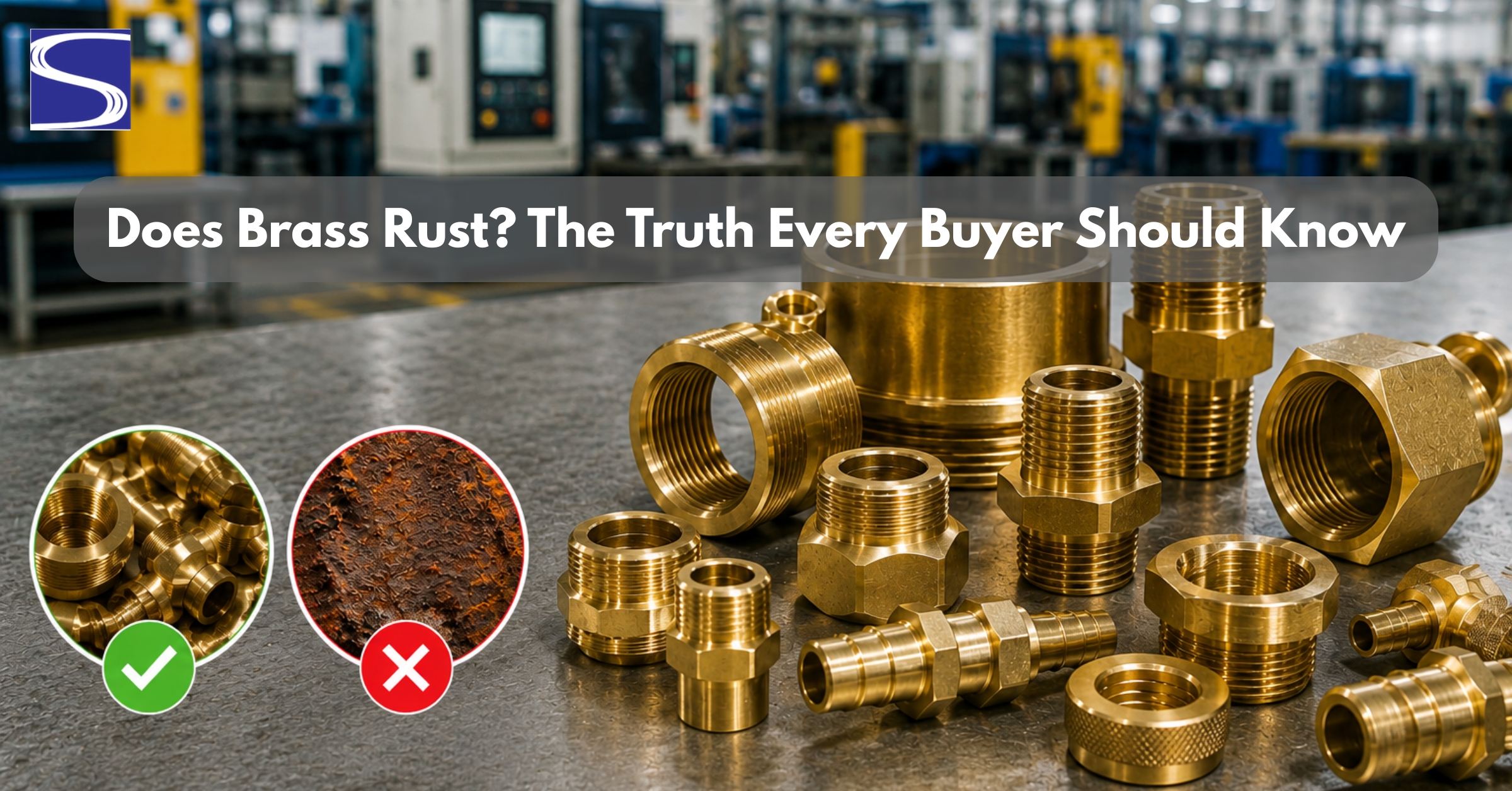
Does brass rust? This is a common question for buyers of metal parts, fittings, and hardware. Knowing how brass will react to moisture, air, and whatever environmental conditions it may face can help you decide if metal is the right choice for your long-term application. Many metals will rust or corrode, but brass is a little different.
This guide will help you if you have ever asked, does brass rust when it comes in contact with water or is exposed to the elements?.
Does Brass Rust Like Iron or Steel?
The answer to the question does brass rust, is no. Like steel and iron, brass does not rust because it is not primarily a combination of iron. Because rust is a product of iron’s interaction with oxygen and moisture, and because brass is made with little to no iron, there is no rust.
Brass is not completely immune to environmental effects. Discoloration and tarnishing, which can be mistaken for rust, may happen to brass over time.
What Happens to Brass Over Time?
While tarnishing does brass rust, the more common issue is oxidation. When exposed to air and moisture, brass can lose its luster and become dull.
Brass corrosion differs from rust. Unlike rust, which appears as a flaky red-brown crust, brass corrosion can appear as a brown, green, or black crust, which is a patina. A patina can protect the surface of the object from further corrosion.
Because of these color changes, many buyers think they are viewing rust on brass, when in fact it is patina from oxidation.
Rust vs. Corrosion: Understanding the Difference
Rusting is the process of brass corrosion that occurs specifically in the metals of the Iron group. Brass has corrosion of brass and does not have Iron oxided rust.
The differences can be summarized as follows:
- Rust occurs in Iron and Steel.
- Brass develops tarnish or patina.
- Rust corrodes and weakens the metal rapidly.
- Oxidation of brass occurs at a much slower rate.
- Brass retains its strength and structure despite the surface discoloration.
This helps to answer the question of does brass rust.
Is Brass Rust Proof in All Conditions?
Another question that buyers have, is brass rust proof in all situations. While brass has great corrosion resistance, every metal can be affected by the environment. Industries that require precision-engineered components often rely on Brass Turned Part solutions because of their durability, corrosion resistance, and excellent machinability.
The answer to is brass rust proof, depending on the conditions and the use of the material. Brass works wonderfully in all dry and especially indoor environments. Because of its properties, it is often seen in plumbing, electrical systems, decorative hardware and industrial fittings.
However, brass can be affected by prolonged exposure to salt water of a high enough concentration to be considered harsh, or to be considered a harsh chemical, or to be in a humid enough environment to be considered harsh. Even under these conditions, brass generally performs better than many other metal alternatives.
Why Does Brass Sometimes Look Rusted?
If brass doesn’t rust, then why do some products look damaged or rusty?
The phrase rusted brass is commonly used when brass develops dark stains or marks of oxidation or other discoloration. In most instances, the appearance of rust is not real rust but is caused by some sort of surface reaction to environmental exposure.
Some common reasons why rusted brass can be observed include:
- Prolonged exposure to moisture
- A buildup of dirt and other surface contaminates
- Exposure to iron particles
- Chemical reactions caused by cleaning products
- Neglect or the absence of regular maintenance
Any of these conditions can create surface markings, like rust on brass that can be mistaken for rust, but in reality, there is no rust present.
Common Causes of Rust-Like Marks on Brass
There are several conditions that cause the discontinuity of the outer surface of brass:
- High-humidity environments
- Exposure to salt air near coastal regions
- Industrial pollutants
- Acidic cleaning products
- Contact with steel tools or iron particles
When customers are asked, will brass rust in these environments or conditions? The answer is still no. However, there can be surface changes if these conditions are not properly controlled.
Prevention of Damage to Brass Surfaces
Brass is a very durable metal but with proper care its appearance and performance can be maintained.
Here are some good maintenance tips.
- Clean regularly with a soft cloth
- Avoid using highly caustic chemical cleaners
- Keep brass parts as dry as possible
- Apply protective coatings as necessary
- Buy from good manufacturers
Just by following these simple steps, you can reduce the chances of oxidation and help keep the original finish of your brass products.
Buyers may be asking if will brass rust after years of use. Proper maintenance will greatly extend the lifespan and appearance of brass components. Understanding the Hardness of Brass can help buyers evaluate its strength, wear resistance, and suitability for various industrial applications.
Why Buyers Choose Brass for Long-Term Applications
Brass is a common material found in the engineering and industrial world because of the great combination of durability, appearance, and resistance to corrosion.
Benefits of brass include:
- Environmentally damage-resistant
- Appealing look
- Great electrical conductivity
- Excellent machinability
- Service life is longer
- Low maintenance
Brass is utilized in many industries for its fittings, inserts, terminals, valves, and precision components. In metal options, the question does brass rust comes about and often leads buyers to select brass for its corrosion resistance over many other materials. The importance of quality manufacturing and attention to detail is highlighted in Crafting Precision, which explores how precision brass engineering contributes to long-lasting product performance.
Conclusion
The answer to the questioned does brass rust is no, brass does not rust in the fashion of iron and steel, as it does not contain any significant amounts of iron. In fact, brass, in its service life, may tarnish or develop a patina on its surface, which is not rust.
Brass is a great material choice for buyers in need of a reliable and corrosion-resistant material for use in both industrial and commercial applications.
FAQs
No, brass does not rust in water. Though tarnishing and patina may occur in prolonged exposure.
No, will brass rust is a common question, but brass typically develops a protective patina rather than true rust.
Brass is used in many industrial applications and proves to be great resistance to corrosion, though it can affect the surface appearance in varying environmental conditions.