
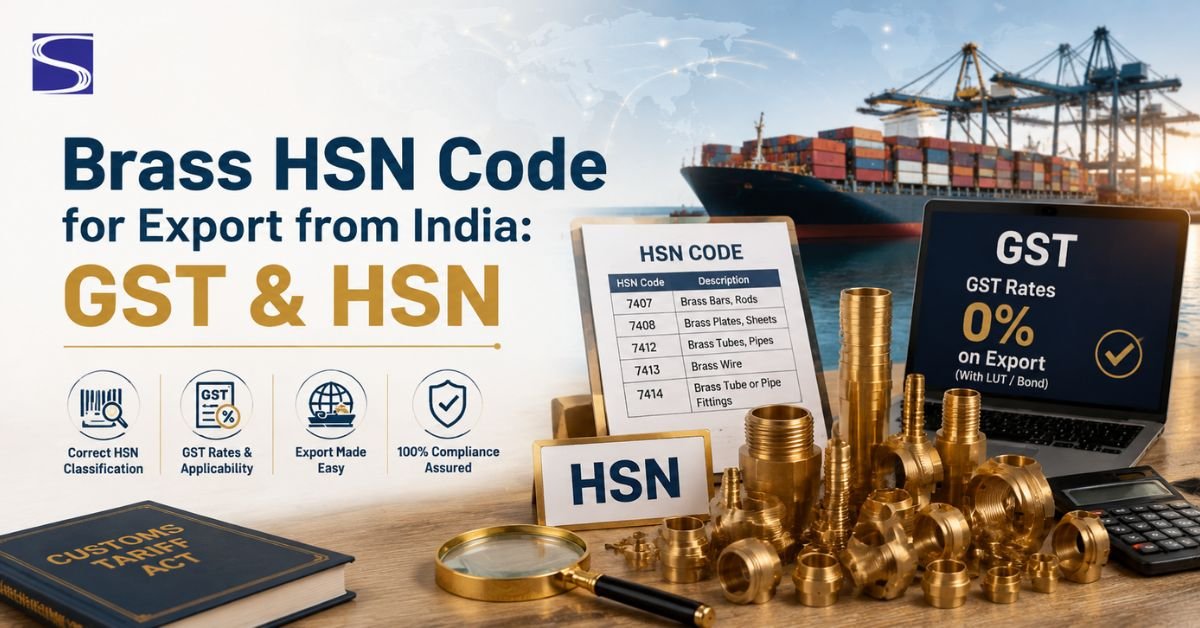
Get the brass HSN code wrong on an invoice and you’ll usually find out the hard way, either through a GST mismatch during filing or a shipment held up at the port over a missing digit. This guide walks through the HSN codes for the brass products exporters deal with most often, the GST rates attached to them, and a few habits that keep the paperwork clean.
What an HSN Code Actually Does
HSN stands for Harmonised System of Nomenclature, an international system for classifying goods for tax and customs purposes. Every product gets slotted into a code, and that code decides a few things at once:
- The GST rate on your invoice
- Customs duty on export or import
- How the item is declared in shipping paperwork
- Whether the product qualifies for certain export benefits
- How everything reconciles when GST returns get filed
Electrical-grade components are a good example of where this gets tricky early on. If you manufacture or source Brass Electrical Parts, the classification often depends on whether the item counts as a brass article or an electrical part, which we’ll get into further down.
Brass HSN Code GST: The Basics
Most brass sits under Chapter 74, which covers copper and copper alloys. Brass, being a copper-zinc alloy, falls in here too.
Here’s the brass hsn code and gst rate breakdown by product form:
- Raw brass (ingots, bars) – HSN 7403, GST 18%
- Brass rods and profiles – HSN 7407, GST 18%
- Brass sheets, strips, and foil – HSN 7409, GST 18%
- Brass tubes and pipes – HSN 7412, GST 18%
- Brass fittings and fasteners – HSN 7415/7418, GST 18%
- Brass scrap – HSN 7404, GST 18%
When the government revises brass hsn code gst slabs, which does happen from time to time, check whether your invoice templates need updating too. It’s easy to miss.
HSN Code for Brass Items, Category by Category
Brass covers a lot of ground as a product category, and the hsn code for brass items shifts depending on what exactly you’re shipping. Here’s how it breaks down.
Rods, Sheets, and Raw Material
This is where most new exporters trip up, since raw and semi-finished material sit under different subheadings.
- Brass rod – HSN 74072100
- Brass sheet/plate – HSN 74091100 / 74092100
- Brass strip – HSN 74091900
If you’re sourcing rolled or precision-thickness material, we go into more detail on sizing and alloys in our guide to Brass Strip.
Fittings, Valves, and Components
- Brass ball valve – HSN 84819090
- Brass pipe fittings – HSN 74122000
- Brass cable gland – HSN 85369090
- Brass electrical connectors and terminals – HSN 85369010
Electrical-grade brass parts trip people up because they sit between two chapters. Chapter 74 covers brass articles, but electrical apparatus falls under Chapter 85 instead. If your product could go either way, ask your CA before you settle on a code.
Scrap and Casting
- Brass scrap – HSN 74040022
- Brass casting – HSN 74199990
Rate Table at a Glance
For quick reference, here’s how the common brass hsn code gst categories line up:
Product | HSN Code | GST Rate |
Brass rod | 7407 | 18% |
Brass sheet/strip | 7409 | 18% |
Brass tube/pipe | 7412 | 18% |
Brass fittings | 7415/7418 | 18% |
Brass scrap | 7404 | 18% |
Brass electrical parts | 8536 | 18% |
GST rates get revised by the council periodically. Before you finalise an invoice, it’s worth confirming the brass hsn code and gst rate are still current rather than assuming last quarter’s numbers still apply.
Finding the Correct Code Without Guessing
If you’re not sure exactly which hsn code of brass fits your product, here’s a process that works:
- Figure out the material form: raw, semi-finished, or finished
- Check whether it belongs under Chapter 74 or a functional chapter like 85 or 84.
- Cross-check against the GST portal’s HSN finder
- Ask your customs broker or CA if the product straddles two categories.
- Keep past shipping bills on hand so future orders stay consistent.
If you’re stuck on the hsn code of brass product in front of you, a customs broker can usually confirm it in a few minutes. That’s faster than guessing and fixing it later at the port.
At Saryu, this isn’t something we sort out at invoicing time. Every product coming off our Brass Production line, raw rods included, gets classified well before it reaches packaging.
Mistakes That Keep Showing Up
- Using the raw material code for a machined, finished component
- Assuming everything brass falls under Chapter 74, electrical parts included
- Sitting on an old hsn code of brass after a GST rate change
- Missing the sub-classification for scrap versus new material
- Reusing one code across product variants without checking each one
- Skipping verification on small shipments because it feels like too much effort for too little volume
None of these are dramatic on their own, but they add up fast once you’re shipping several product lines in one consignment. Since the hsn code for brass items you handle can span more than one chapter, a quick check before invoicing goes a long way.
What This Means for Your Documentation
Once the wrong brass hsn code lands on an invoice, it doesn’t stay contained there. It shows up again on the shipping bill, the packing list, and the certificate of origin, and fixing it after the fact almost always means delays. Our walkthrough on Export Documentation covers the full checklist if you want to see where this fits into the bigger picture.
This attention to the hsn code for brass items we manufacture is part of what keeps paperwork accurate for buyers overseas.
Conclusion
Brass HSN classification isn’t glamorous work, but it’s the kind of detail that either saves you time or costs you time, depending on whether you get it right the first time. Confirm the brass hsn code and gst rate before you invoice, keep an eye on rate changes, and treat electrical-grade parts as their own category rather than lumping them in with everything else. It’s a small habit that keeps shipments moving.
Frequently Asked Questions
Most brass products sit under Chapter 74, with codes running from 7403 for raw brass to 7415-7418 for fittings and fasteners, depending on the form.
Most brass items, including rods, sheets and fittings, carry 18% GST, but it’s worth checking the current rate for your exact code.
Yes. HSN 7404 is normally used for scrap, and other codes such as 7407 or 7409 are used for new or finished brass.
Not always. Electrical-grade components often sit under Chapter 85 rather than Chapter 74, so it’s worth checking with a customs expert.
You can start with the HSN finder on the GST portal or you can get it confirmed from your customs broker or CA for your particular product.