
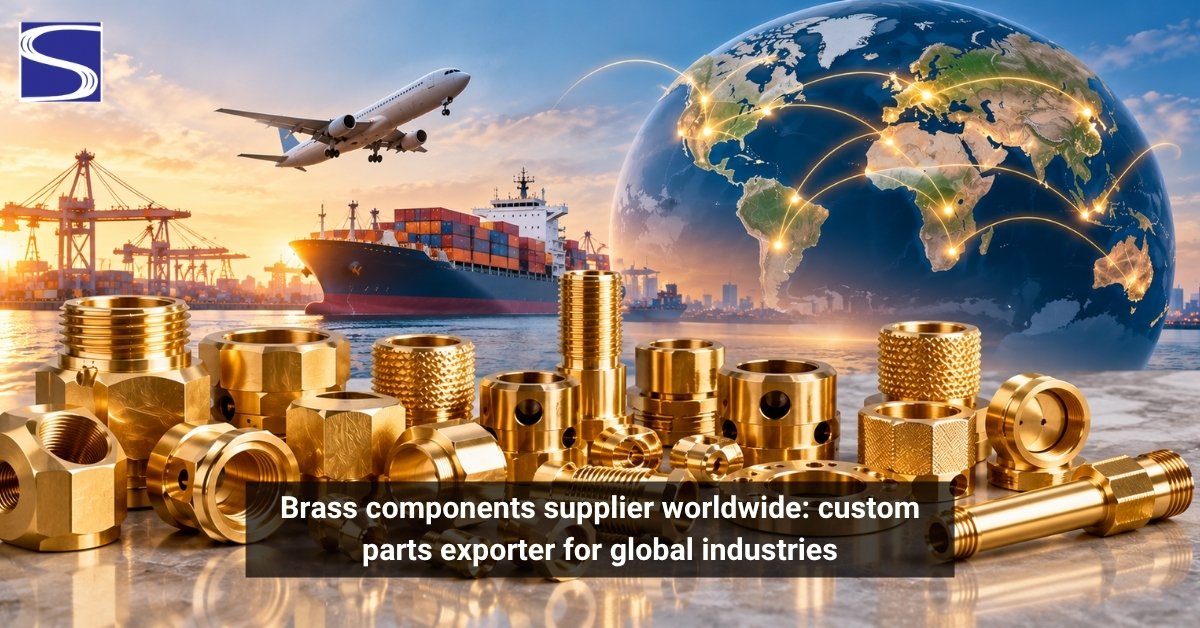
Picking a brass components supplier worldwide sounds simple until the first shipment lands. Then you find out whether the threads gauge properly, whether the plating holds, and whether the 40,000 pieces you ordered are really 40,000. OEMs, distributors and engineering firms all run into the same problem. A good partner ships parts that match the drawing and arrive when promised. A bad one leaves you paying for air freight to cover a late container. This guide walks through what a global brass supplier actually does, the parts most buyers import, and the checks worth doing before a bulk order.
Brass shows up everywhere in plumbing, electrical, automotive and hardware products. It cuts cleanly on a lathe, it doesn’t rust, and it carries current well. It also looks decent with or without plating, which matters more than people admit. Because the demand is steady, many top brass manufacturers have set up export desks, in-house tool rooms and small testing labs. A buyer in Germany or Texas can now order precision parts from Asia and get the same result as from a local shop. That only holds if the supplier is chosen with some care.
It helps to know the metal before you compare quotes. Brass is mostly copper and zinc, and shifting that ratio by a few percent changes strength, colour and how easily the bar machines. Add a little lead, tin or aluminium and the behaviour changes again. If you want the full breakdown, What Is Brass Made Of explains what each element does.
What does a brass components supplier worldwide do?
A brass components supplier worldwide makes precision brass parts and ships them to buyers in other countries. The job starts with buying the right rod or billet. Then comes machining or forging, plating if needed, inspection, packing and the export paperwork. In plain terms, you send a drawing and get back a finished part at your warehouse. Most exporters also prepare the certificate of origin, packing list and commercial invoice, so your customs broker isn’t chasing documents at the port.
Working with a top brass company usually gets you some free engineering help too. A decent supplier will look at your drawing and tell you if a tolerance is tighter than it needs to be, or if a different alloy would machine faster. Sometimes the suggestion is tiny, like a slightly bigger radius or a change in thread form. Small changes like that can cut cycle time without touching how the part works. Over a few years of repeat orders, the savings add up.
Types of brass components exported globally
Most export orders fall into a handful of product groups. Each one serves a different industry, and plenty of buyers pull several types from one factory to keep things simple. One vendor means fewer shipments to track, fewer audits and fewer purchase orders sitting in someone’s inbox.
- Turned parts made on CNC and sliding head lathes, such as bushes, spacers and connectors with tight tolerances.
- Pipe fittings, compression fittings and valve parts for plumbing and gas lines.
- Electrical parts like terminals, neutral links and earthing components, where conductivity matters.
- Fasteners, including nuts, bolts, screws and threaded inserts for moulded plastic.
- Forged and cast parts such as valve bodies and sanitary fittings made by hot forging or sand casting.
Raw material and export classification
Customs codes trip up more first-time importers than you would expect. Put the wrong code on an invoice and the container can sit in clearance while someone argues about duty. In some markets you also risk a penalty. Suppliers who export every month know which codes apply to rods, sections, fittings and finished parts, and they get them right on the paperwork. For rod stock in particular, Brass Rod HSN Code covers how brass rods are classified for trade.
How to choose the right brass parts supplier
A good brass parts supplier shows you proof instead of telling you how good they are. Ask for samples, inspection reports and the name of a buyer in your region you can speak to. If you can’t visit, ask for a video walk through the machine shop. It’s a quick way to see whether the place is organised. A serious brass components supplier worldwide will share all of this without fuss and send a quote that spells out lead time, MOQ, payment terms and Incoterms like FOB or CIF.
Certifications are the next filter. Many top brass manufacturers hold ISO 9001 and supply RoHS and REACH compliant parts for Europe and the US. Some offer lead-free alloys for drinking water fittings that need NSF approval. Ask for a material test certificate with every batch. Exporters who do this properly also keep records that link each lot back to the heat number of the raw material, so if something goes wrong you can trace it.
Process knowledge shows up in the part
You can usually tell how well a factory understands brass by looking at its castings and forgings. Heat control is everything here. Run the furnace too hot and you lose zinc, get porosity and end up with weak spots that crack under pressure. Too cold and the die doesn’t fill, so you see cold shuts on the surface. Good shops watch furnace and die temperatures through the whole run. The ranges they work with are covered in Brass Melting Temperature Explained.
Factor | What to check | Why it matters |
Quality certification | ISO 9001, material test certificates | Shows production is consistent |
Compliance | RoHS, REACH, lead-free options | Needed for EU and US markets |
Capabilities | CNC turning, forging, casting, plating | Fewer vendors for mixed orders |
MOQ and lead time | Sample timeline, bulk delivery date | Keeps your production on plan |
Export experience | Incoterms, documents, packing | Avoids trouble at customs |
Quality control global buyers expect
This is where average exporters and good ones split apart. A capable factory checks raw material when it arrives, approves the first piece off each machine and then measures parts at set intervals during the run. Final inspection follows an agreed AQL sampling plan before anything goes into a carton. Every check gets written down, so a problem can be traced to a specific machine, operator or material lot.
Ask what they measure with. Thread gauges, micrometers, height gauges, a profile projector and ideally a CMM tell you the shop takes dimensions seriously. For plated parts, a coating thickness tester and a salt spray chamber mean they can prove corrosion resistance rather than hope for it. If your parts hold pressure, ask for leak test reports with every shipment. It costs the supplier very little and saves you a lot of worry.
Tolerances, PPAP and first article inspection
Automotive and industrial buyers often want a PPAP file or a First Article Inspection Report before mass production starts. Both documents prove the supplier can hit every dimension on the drawing, again and again. Turned brass parts commonly hold plus or minus 0.02 mm, and tighter is possible on the right machines. Agree on the critical dimensions early. Otherwise inspection time gets spent on features that don’t affect your assembly at all.
Common brass grades used in export parts
The grade you pick affects price, machining speed and how the part behaves in use. Free-cutting brass, listed as CZ121, CW614N or C36000 depending on the standard, is the usual choice for turned parts. The small lead content breaks chips cleanly, so tools cut fast and leave a good finish. Forging brass such as CW617N or C37700 flows well in hot dies, which is why it’s used for valve bodies and heavier fittings. Match the grade to the process and scrap stays low.
Some jobs need something more specific. Dezincification-resistant brass like CW602N goes into fittings for aggressive water, where ordinary brass slowly weakens. Lead-free and low-lead grades meet drinking water rules in the US and Europe. Naval brass, with a bit of tin added, holds up better near seawater. Whatever you need, write the grade and standard on the drawing and ask the supplier to confirm it on the test certificate for each lot.
Brass parts wholesale vs custom orders
There are really two ways to buy. Brass parts wholesale works for distributors and retailers who need standard fittings and fasteners in big volumes at a low unit price. Custom orders make sense for OEMs whose parts are built to their own drawings, alloys and finishes. Which one fits depends on how unique your product is, how much stock you can carry and how fast you need it.
- Wholesale orders cover standard catalogue parts, ship faster and get cheaper as volume grows.
- Custom orders are made to your drawing, a physical sample or a 3D model.
- Finishes can be natural, nickel, chrome, tin or silver plated.
- Packing can be bulk cartons, polybags or private-label boxes for resellers.
- Plenty of buyers mix the two, using brass parts wholesale for standard items and custom runs for the critical ones.
Industries that rely on exported brass components
Plumbing and sanitary brands buy more brass parts than anyone. Taps, valves, pipe connectors and manifolds use brass because the right grades resist dezincification and handle hot and cold water for decades. Gas equipment makers use it for regulators, burner nozzles and cylinder valves. Brass doesn’t spark easily, and the threads survive being tightened over and over.
Electrical is the other big market. Switchgear, meters, plugs, sockets and terminal blocks need brass for stable conductivity and reliable contact. Automotive and HVAC companies buy sensor housings, hose fittings and refrigeration connectors. Then there’s the decorative side. Furniture, lighting and architectural hardware brands order polished, antique or satin finish parts for their premium ranges.
Export logistics, packing and lead times
Fast machines don’t guarantee on-time delivery. A reliable exporter buys raw material ahead of time, books machine hours honestly and arranges freight before the parts are finished. Samples usually take two to four weeks. Bulk orders take four to eight, depending on quantity, tooling and plating.
Packing matters on a 30-day sea voyage. Parts should be cleaned, dried and wrapped in anti-tarnish paper or VCI bags so they don’t oxidise in a humid container. Strong cartons, proper palletising and labels with part numbers and quantities make life easier for whoever unloads at your end. Ask whether the supplier ships by sea, air or courier, and whether their forwarder knows your destination port.
Why global buyers source brass components from India
Jamnagar in Gujarat has one of the biggest clusters of brass part makers anywhere. Labour is skilled, tooling is mature and prices are competitive, which explains why so many top brass manufacturers there ship to the USA, UK, Europe, the Middle East and Australia. Buying from a brass components supplier worldwide based in that cluster puts machining, forging, casting and plating within a few kilometres of each other. Samples come back faster because the supply chain is short.
When quotes from a top brass company land on your desk, look past the price per piece. Part weight, alloy grade and composition all drive material cost and how the part performs in the field. A cheaper quote might use less copper or a lighter blank that won’t meet your spec. Brass Weight and Composition shows how these factors change both the application and the price.
Conclusion
The right brass components supplier worldwide gives you parts that pass inspection, paperwork that clears customs and containers that show up on time. Start with the alloy and grade your application needs. Then check certifications, get samples and read the inspection reports before you commit to volume. Confirm packing and lead times so nothing surprises you at the port. A top brass company that handles both standard and custom parts will keep your supply chain simpler and your costs steady for years.
FAQs
Check certifications, ask for samples and inspection reports, and confirm they already ship to buyers in your country.
A typical brass parts supplier accepts custom orders from about 500 to 1,000 pieces, depending on part size and process.
Free-cutting brass such as CZ121 (C36000) is the most common pick because it machines fast and leaves a clean finish.