
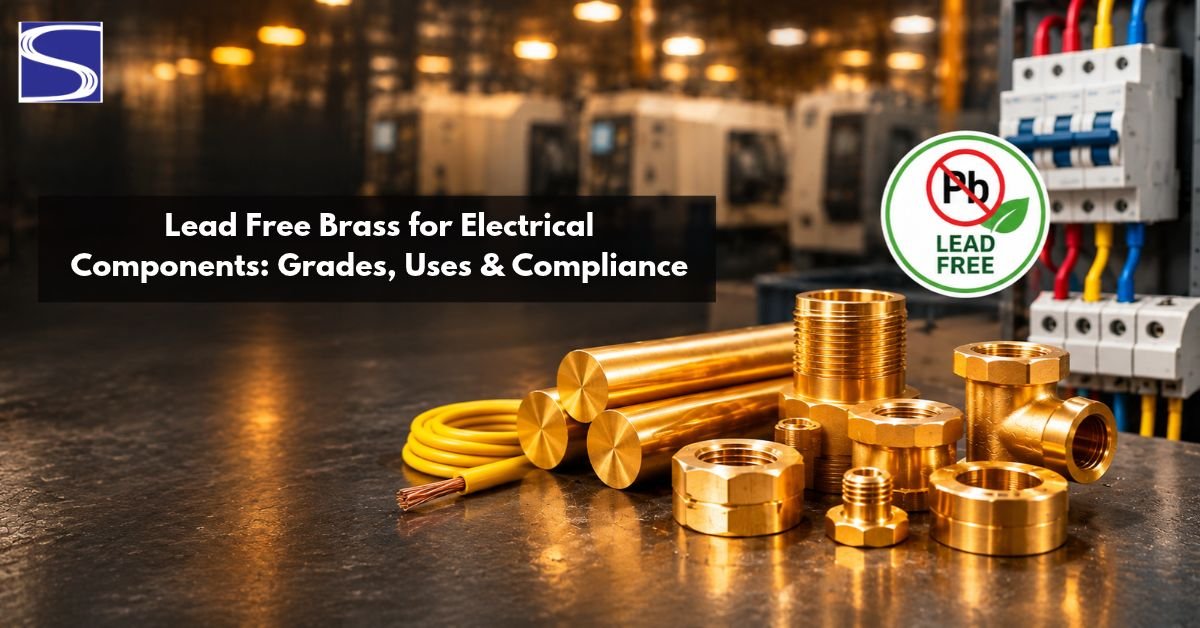
Ask ten electrical buyers why they want lead free brass for electrical parts, and most will give the same answer: an export customer asked for it. That’s how it starts for many Indian manufacturers. The material question usually arrives inside a purchase order.
The shift is real, though. Europe has tightened its lead rules, Indian e-waste rules follow similar limits, and global brands now check material certificates before they check prices. If you make or buy terminals, pins or socket parts, this is worth understanding properly.
What Is Lead Free Brass?
So, what is lead free brass? It’s a copper-zinc alloy made with little or no added lead, usually below 0.1% by weight. Standard machining brass carries around 2.5% to 3.7% lead because lead helps the metal cut cleanly. When you request quotes for Brass Electrical Parts, mention leaded or lead-free upfront, because the grade changes both price and lead time.
Lead never did anything for conductivity. It sat in the metal as tiny particles that broke chips off the cutting tool. Remove it, and the part works just as well electrically. The difference shows up on the shop floor, not in the switchboard.
In short, it’s the same family of metal with different behavior on the machine. Your customer won’t notice any change in the finished product, but your machine operator definitely will.
Lead Free Brass Composition: What Goes Into It
Copper and zinc still do most of the work. What changes in a lead free brass composition is what replaces the lead, if anything replaces it at all.
Some grades simply leave lead out and accept slower machining. Others add silicon, bismuth or phosphorus to make chips break more easily. Silicon brass is the most common of these replacements in electrical and plumbing parts today.
A good lead free brass composition for electrical parts keeps copper high enough for decent conductivity and corrosion resistance. Too much zinc makes the alloy brittle. Too little copper, and contact parts heat up under load. This balance matters more than most buyers realize, especially in parts that carry current every day.
Common Lead Free Brass Grades for Electrical Use
There are many lead free brass alloys on the market, but three come up again and again in electrical work. Here’s how they compare in practice.
C26000 (CW505L) Cartridge Brass
This grade is roughly 70% copper and 30% zinc, with lead kept to trace levels. It bends and stamps beautifully, so it’s the usual pick for strips, contacts and pressed terminals. It isn’t great for heavy CNC turning.
CuZn37 (CW508L)
With about 63% copper, this grade costs less and still forms well. Many neutral links, strips and pressed socket parts use it. Lead stays at or below 0.1%.
Silicon Brass (C69300 / CW724R)
This grade is around 75% copper with roughly 3% silicon. It’s the main option when you need lead free brass grades that can be machined on CNC lathes. It’s strong and resists corrosion well. One catch: its electrical conductivity is much lower than cartridge brass, so it suits screws, bushes and housings better than current-carrying contacts.
Picking between these lead free brass alloys depends on how the part is made as much as how it’s used. A stamped part and a turned part rarely need the same grade. The wrong choice often shows up later as loose contacts or heat marks inside a panel, which is a big reason Quality Brass Components make a real difference in electrical systems.
A quick shop-floor tip: when a turning job moves from leaded brass to silicon brass, run a short trial first. Feeds and speeds usually need adjusting, and chips come off longer, so chip control needs attention. Skipping the trial is how most first batches end up with poor thread finish.
Where Lead Free Brass for Electrical Parts Is Used
Lead-free material is now standard in products sold into Europe, and it’s spreading to domestic projects too. Typical applications include:
- Terminals for MCBs, switches and distribution boards
- Plug pins and socket contacts
- Neutral links and earthing bars
- Cable gland bodies and locknuts
- Fuse contacts and holder pins
- Connector inserts for electronic equipment
A practical example: a switchgear maker exporting to Germany may need lead free brass for electrical terminals, while the same company’s Indian product line still uses standard brass. Many factories now run two material streams side by side, with separate racks, separate labels and separate inspection records so the two never mix.
The starting form of the metal matters here too. Stamped terminals usually begin as brass strip, while turned pins and inserts begin as a rod, and each one behaves differently once the lead is removed. Our article on How Is Brass Manufactured explains how rods, strips and castings are made, which makes the grade choice much easier.
Compliance: RoHS and What It Means for You
Under the EU RoHS directive, lead is capped at 0.1% by weight in each homogeneous material. An exemption, known as 6(c), still allows copper alloys with up to 4% lead. That exemption currently runs until 30 June 2027 for all equipment categories, after which leaded brass could become much harder to sell into Europe.
India’s E-Waste (Management) Rules carry similar hazardous-substance limits for electrical and electronic equipment. So switching to lead free brass for electrical products isn’t just an export issue anymore.
Our advice is simple. Don’t wait for 2027. Buyers who change late usually pay more, because tooling and machining parameters need time to adjust.
Practical Tips for Buying Lead Free Brass Components
Ordering lead free brass components isn’t hard, but a few checks save a lot of back-and-forth:
- Name the exact grade on your drawing, not just “lead-free”
- Ask for a mill test certificate showing lead content
- Request a RoHS declaration with every batch
- Check conductivity needs before choosing silicon brass
- Expect slightly higher prices due to slower machining
- Approve samples from a production run, not a prototype
Picture a buyer who writes “LF brass” on a terminal drawing and receives a low-lead plumbing grade that fails his customer’s RoHS test. A single grade name on the drawing would have avoided it.
Experienced suppliers will also guide you on whether your parts should be turned, stamped or forged for your design. For more on standards, part types and sourcing from Jamnagar, see our guide on Brass Electrical Parts Export from India.
Conclusion
Choosing lead free brass for electrical work is now a practical business decision, not a niche request. Pick the grade based on how the part is made and whether it carries current, ask for proper test certificates, and plan your switch well before the 2027 RoHS deadline. Get those basics right, and your parts will pass compliance checks in India and abroad without costly surprises.
FAQs
Lead free brass is mainly copper and zinc, with lead kept below about 0.1%. Some grades add silicon or bismuth to improve machining.
C26000 and CuZn37 work well for stamped terminals and contacts. Silicon brass suits machined parts where conductivity is less critical.
Usually a little, because it machines more slowly and wears tools faster. The gap narrows on stamped parts.
They can be, if lead stays at or below 0.1% in the material. Always ask your supplier for a RoHS declaration and a test certificate.
Grades like C26000 conduct about the same as leaded brass. Silicon brass conducts noticeably less, so check your current rating first.