
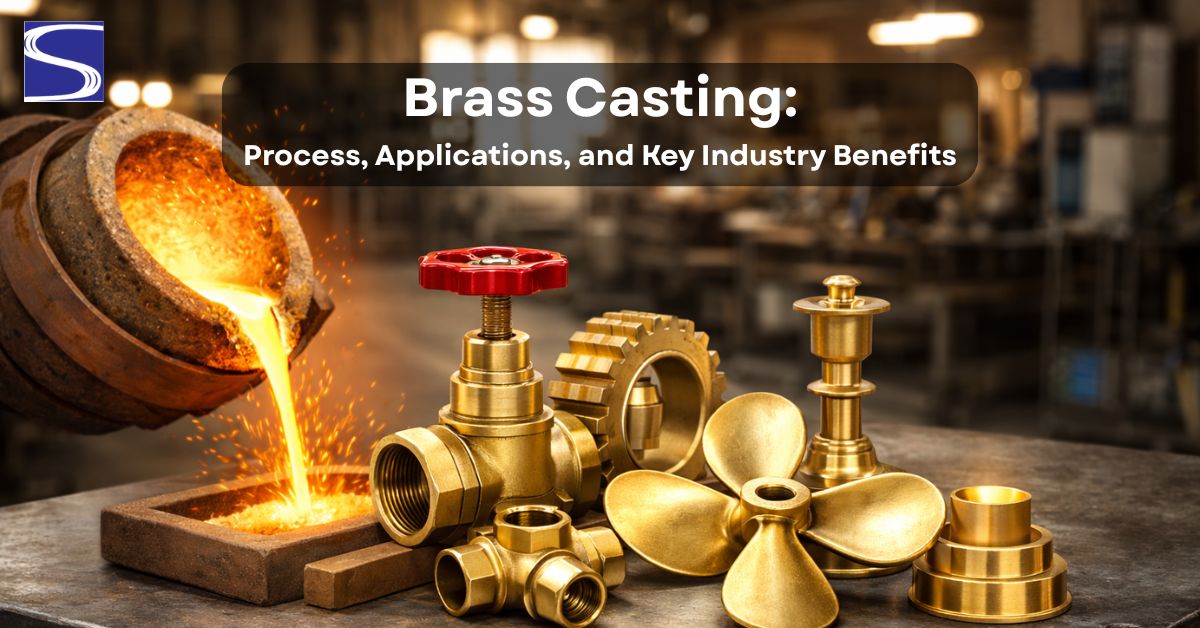
Brass casting has long been used in industry for producing metal components which provide long-lasting, dimensionally accurate, and corrosion resistant parts. The industry has relied on this method for parts which provide strength, machinability and long service life. As the complexity and scale of brass metal casting continues to evolve, industrial manufacturing has brass metal casting as a go-to solution.
With the wide range of metal components used in industries, brass is the top choice for manufacturers as it provides consistent performance and supports a wide range of applications. A better understanding of the composition and properties of brass helps industries make informed decisions when selecting components, and this is why brass manufacturers in india continue to play a crucial role in supplying reliable brass components for diverse industrial requirements.
What Is Brass Casting?
Brass casting involves pouring molten brass into a prepared casting and then after the brass is solidified, it is removed from the mold. The entire process results in the creation of a final component, and is helpful in creating components which are difficult to create through machining processes.
The brass metal casting process helps in the construction of highly complex structures that others methods cannot help with, thus it is highly beneficial for large manufacturing enterprises. It is also highly adaptable and with efficient construction. It is also the best for rather demanding applications as it possesses highly uniform construction properties.
Types of Brass Used in Casting
Common Brass Alloys for Casting
Depending on the purpose, many different varieties of brass alloys can be used:
- Yellow brass which is good in strength and resistant to corrosion
- Red brass which is durable and has more copper
- Leaded brass which is better for machining
- High strength alloys which can be used for super industrial parts
Importance of Alloy Selection
Right alloy is key for it to perform properly. Brass alloy system of casting allows the manufacturer to channel the needed mechanical strength, corrosion resistance and thermal conductivity to preferred operational parameters. Right alloy guarantees the industrial system output in terms of stability and longevity.
Brass Casting Process Explained
Step-by-Step Production Flow
Maintaining Quality and standards is a priority in the brass casting process. A sequence of controlled steps is followed:
- Choosing good quality raw brass
- Melting the alloy at controlled temperatures
- Mold preparation based on component design
- Pouring molten metal into the mold cavity
- Controlled cooling and solidification
- Trimming, finishing, and inspection
Following this sequence in the brass casting process, the quality of mechanical characteristics and accuracy of dimensions is assured in the castings and across different production runs.
Common Casting Methods
In manufacturing, depending on the complexity and quantity, the following techniques are used:
- Sand Casting: This is used for large or complex parts.
- Die Casting: This is used for large-scale production.
- Investment Casting: This is a complex process but offers superior finishes
- Gravity Casting: This process is applicable for heavy, dense pieces.
Precision Brass Casting for Industrial Requirements
Precision brass casting guarantees low variability in tolerances and dimensions in the manufactured component. This is essential for plumbing and electrical component manufacturing.
Brass Pins and many other highly complex and stressed components achieve consistent results through a fine blend of controlled tooling, excellent mold design, and strict inspection methods.
Applications of Brass Casting Across Industries
Industrial Usage Scenarios
Brass casting for industrial use is very common and can be seen in the following industries:
- Electrical terminals and connectors
- Valves and fittings for plumbing
- Components and bushings for automobiles
- Parts for industrial machinery
- Mechanical and flow control assemblies
These examples also utilize brass’s resistance to wear and corrosion and stability in fluctuating temperatures.
Custom Manufacturing Solutions
Custom brass casting provides solutions for manufactures who require unique shapes or other custom features, custom dimensions, or application-specific features. It also offers flexible production solutions for prototypes, full-scale manufacturing runs, and low-volume orders and for all of these scenarios maintains consistent quality of the materials.
Key Benefits of Brass Casting
Technical Advantages
- Tough against corrosion and oxidation
- Great durability with mechanical stresses
- Reliable performance with both high and low temperatures
- Post-casting machining and finishing is easy
Manufacturing & Business Benefits
- Mainly Large to Medium scale production
- Minimization of production failure and scraps
- Design of the cast can be flexible
- Great operational lifespan of the components
The above are the reasons why many manufacturers choose brass casting.
Why Work with Experienced Brass Casting Manufacturers?
Brass casting manufacturers stick to the process and the way it should be done. Quality is consistent, there is alloy control, and the process flow is efficient. Reliable manufacturers have the expertise, the casting technology, and the industry standards to do the crunching quality control.
Reliable manufacturers are also able to support high-volume production and enable a seamless transition from low-volume to large-scale manufacturing without sacrificing quality, including for precision components such as Brass Terminals.
Quality Standards in Brass Alloy Casting
Quality control is crucial to brass alloy casting. Manufacturers have to do quality checking in order to meet the qualities standards of the industry. This involves checking the chemical composition, the size, the surface finish, and the mechanical properties.
When these qualities are meets, the components are certain to perform well in the operational environments.
How Saryu Industries Supports Casting Requirements
Saryu Industries keeps your business on track by attending to each of your casting needs. The company focuses on potential fabrication problems with different dimensions, distance variations, etc., to assist with either standard or specialized industrial fabrication.
Due to having a rigorous process to ensure each part is completed to one or more of the specifications, Saryu is able to assist with the more mechanical focused aspects of a job.
FAQs on Brass Casting
Why is brass a good material to use for casting?
Brass has the best usability because of its flow properties, is not easily corroded, and is very strong.
Is using brass for casting good for creating complex designs?
Yes, to put it simply, the casting process is good for designing and creating complex geometrical and detailed shapes.
What is the primary difference between casting and machining parts with brass?
While machining brass parts is more suited for creating simple shapes, casting is ideal for complex designs and uses less material.
Is it possible to use brass casting for large-scale production?
Yes, it is possible. With industrial brass casting, the process is very efficient, even for large and small medium productions.
Will the process of casting reduce the durability of brass?
If the casting of brass is closely controlled, the durability and strength will not be reduced.
Conclusion
Brass casting is still a reliable method of creating durable and ready to use parts for durable industrial assemblies. With the right processes and alloys, and driven manufacturing expertise, the industry will meet the more demanding quality and longevity requirements. Of all the industrial manufacturing options, brass casting still holds an important place, regardless of whether standard or custom components are needed.