
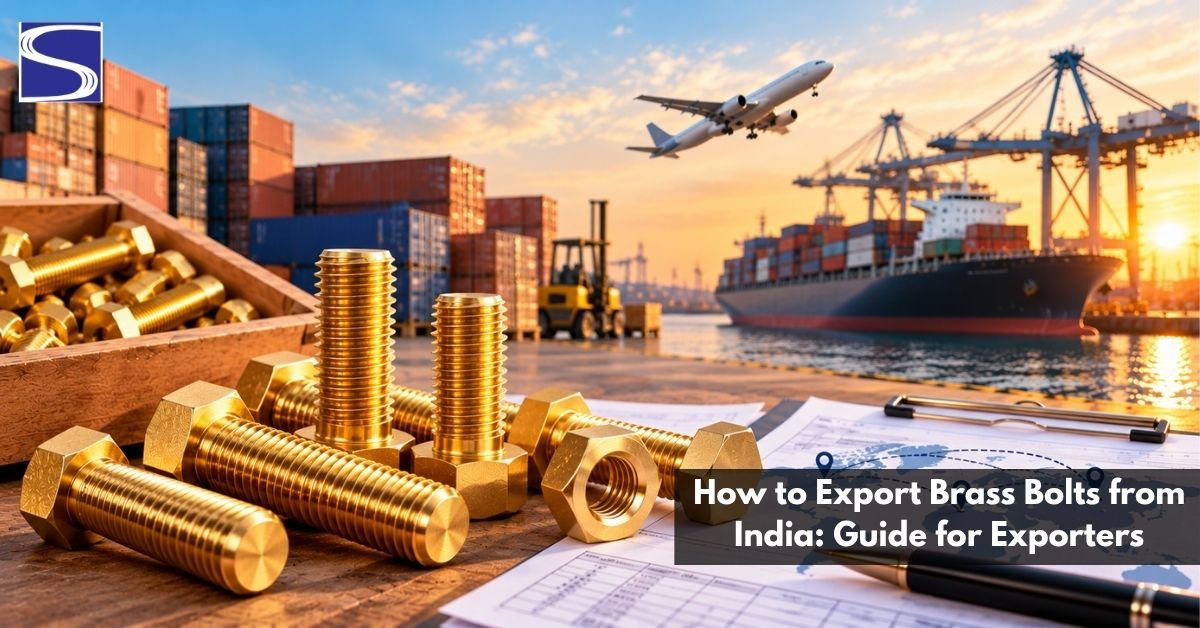
Getting your first overseas order feels great. Then the paperwork shows up. If you want to export brass bolts, the product itself is usually the easy part, because Jamnagar factories have been making precision brass parts for decades. What trips people up is everything around it: registrations, HSN codes, buyer checks and shipping terms that nobody explains properly.
This guide covers the process the way it actually works on the ground. If you want a quick look at the product range first, our brass bolts page lists the types, grades and standards we make.
Why Brass Bolt Export from India Keeps Growing
Buyers in Europe, the Middle East and the US keep coming back to Indian suppliers, and it isn’t only about price. A big share of brass bolt export from India comes out of the Jamnagar cluster in Gujarat. There, brass rod suppliers, machining units, plating shops and packers all work within a few kilometres of each other.
That closeness matters more than people think. A buyer who needs M6 hex bolts in CW614N with nickel plating can get samples in days, not weeks. Mundra and Kandla ports are also a short drive away, so inland freight stays low.
How to Export Brass Bolts Step by Step
If you’re new to this, here is how to export brass bolts without losing months to trial and error. Do things in this order. Skipping ahead usually means redoing something later.
1. Get Your IEC
The Importer Exporter Code comes from DGFT, and you can’t export anything without it. You apply online with your PAN, bank details and address proof. In most cases it comes through within a day or two.
2. Register with EEPC India
Fasteners count as engineering goods, so your Registration Cum Membership Certificate (RCMC) comes from EEPC India. You need it to claim most export benefits, so don’t leave it for later.
3. Classify the Product Correctly
Brass bolts fall under HSN 7415, the heading for copper and copper alloy articles. Steel bolts go under 7318. Mixing these two up happens more often than you’d expect, and it causes delays at customs on both ends. GST on brass fasteners is generally 18%, but you can ship under a Letter of Undertaking (LUT) and avoid paying IGST upfront.
4. Find and Check Your Buyers
Trade fairs, B2B portals and EEPC buyer seller meets all work well. Before you quote, ask every new buyer for a drawing, the thread standard and the finish they want. A price without specs is just a guess.
5. Agree on Shipping and Payment Terms
Documents You Need for Every Shipment
Most first orders go on FOB or CIF terms. New buyers usually start with an advance payment or a letter of credit, and open terms come later once there’s some trust. For example, a 300 kg trial order of M8 hex bolts to Dubai can go as LCL sea freight from Mundra, and the sea leg to Jebel Ali is short.
Here’s the paperwork a typical shipment needs. Your freight forwarder or CHA will prepare part of it, but you should still know what each document does.
Document | Who Issues It | Why It Matters |
Commercial Invoice | Exporter | Shows value, HSN code and terms of sale |
Packing List | Exporter | Lists cartons with net and gross weight |
Shipping Bill | Indian Customs (ICEGATE) | Main export declaration in India |
Bill of Lading or Airway Bill | Shipping line or airline | Proof the goods were loaded |
Certificate of Origin | EEPC or chamber of commerce | Helps the buyer claim lower import duty |
Material Test Certificate | Exporter or testing lab | Confirms brass grade and composition |
What It Takes to Export Brass Bolts Without Rejections
Paperwork gets the goods out of India. Quality gets you the second order. A rejection hurts a lot more when the cartons are already sitting at a port in Hamburg, so if you plan to export brass bolts regularly, build these checks into your dispatch routine:
- Check lead content against the rules of the destination country. EU buyers often ask for RoHS and REACH compliance, and some US buyers want lead free grades for plumbing use.
- Measure threads with go and no go gauges, not by eye. One batch of tight threads can sink an entire order.
- Keep records of plating thickness. Nickel and tin finishes get tested on arrival more often than most new exporters expect.
- Pack by weight, not just by count. Brass is heavy, and overloaded cartons tend to split open in transit.
- Share sample photos with measurements before dispatch. Buyers like seeing the actual lot, not a catalogue image.
- Label each carton with size, grade, lot number and quantity. The buyer’s receiving team will thank you for it.
Working with an established manufacturer that also produces matching brass screws makes this easier. Your buyer can source bolts and screws in the same grade and finish from one supplier, so these checks become routine work instead of a last minute rush.
One practical tip. When you first export brass bolts to a new country, send a small trial order. It shows you how customs, transit time and packaging hold up before you commit to a full container.
A quality gaseous furnace is used to melt copper, and then zinc in a controlled manner is used to blend with the copper, producing a brass alloy. This is one of the critical stages in the manufacturing of brass on which many industries are dependent.
What Buyers Look for in a Brass Bolt Exporter
Now flip it around and think like the buyer. An importer in Dubai or Rotterdam has plenty of options, so why would they pick one brass bolt exporter over another?
Honestly, it comes down to fairly boring things: batches that match each other, quick and clear answers to technical questions, and delivery dates that actually hold. A brass bolt exporter who quotes a little higher but never misses a date often wins over the cheapest offer on the table.
Mistakes Brass Fasteners Exporters in India Should Avoid
The same problems come up again and again among smaller brass fasteners exporters in India. Most of them are easy to fix once you know about them.
Quoting without a drawing is the biggest one. Underpricing to win the first order is another, because raising prices later is much harder than it sounds. Some exporters ignore currency movement and lose margin when the rupee shifts between quote and payment. Quite a few also forget to claim the RoDTEP benefits they’re entitled to.
If you’d like a wider view of how brass compares with steel and other materials in fastening work, this article on metal fasteners explains the basics clearly.
Conclusion
The process to export brass bolts from India isn’t complicated once you’ve done it a couple of times. Get your IEC and RCMC sorted, use the right HSN code, and keep your documents clean.
After that, it’s really about quality and keeping your word. That’s what separates the brass fasteners exporters in India who get repeat orders from the ones chasing new buyers every month.
FAQs
Brass bolts usually come under HSN 7415, which covers screws, bolts and nuts made of copper or copper alloys. Confirm the full 8 digit code with your CHA before filing the shipping bill.
The IEC is the first must have, but you’ll also want an RCMC from EEPC India to claim export benefits. Without it, you leave money on the table with every shipment.
File a Letter of Undertaking (LUT) on the GST portal at the start of each financial year. It lets you ship at zero rate without paying IGST first and then waiting for a refund.
Common destinations include the UAE, the US, Germany, the UK and parts of Southeast Asia. Most demand comes from the electrical, plumbing and hardware industries.
Ask for a material test certificate, a sample lot and references from current export clients. A short factory visit or even a video call of the shop floor tells you a lot.