
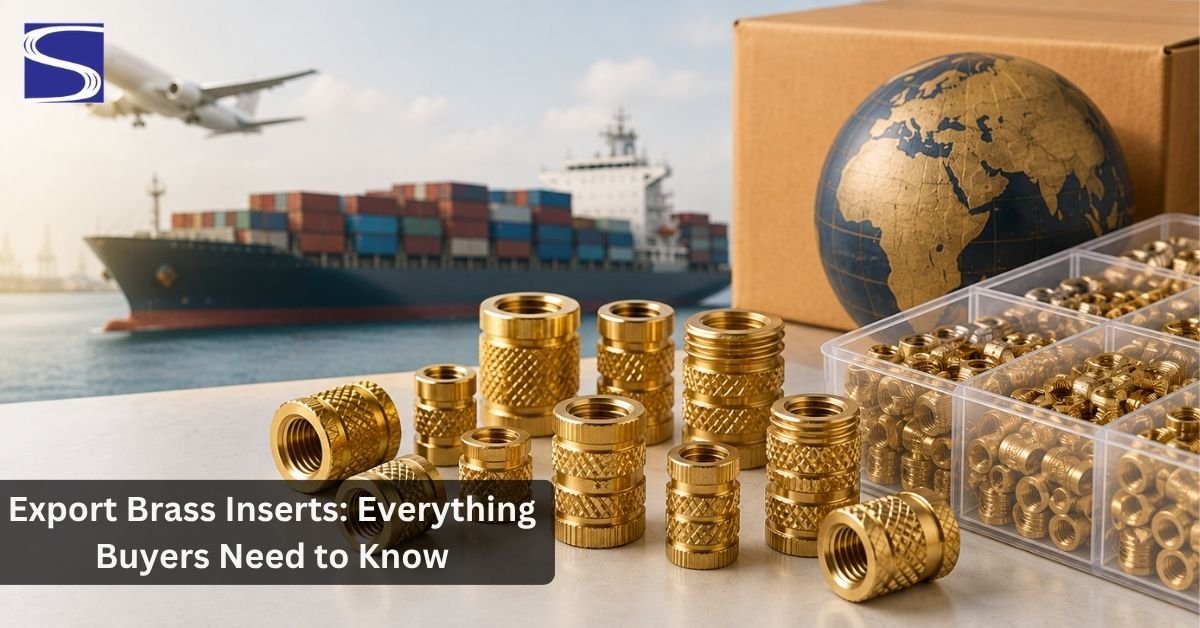
If you’re planning to export brass inserts for the first time, the process can feel more complicated than it needs to be. Between HSN codes, packaging standards, and finding a supplier who actually ships on time, there’s a lot to get right before the first container leaves the port. This guide walks through what matters most, based on how the process actually works for buyers sourcing from India today.
What Brass Inserts Are, and Why the Details Matter
Brass inserts are small threaded components pressed or molded into plastic, wood, or metal parts to create a strong, reusable connection point. They show up everywhere: electrical panels, automotive assemblies, furniture hardware, even 3D-printed enclosures that need a metal thread instead of a plastic one.
The catch is that a badly made insert doesn’t fail immediately. It fails three months later, after the thread strips or the part works loose under vibration. That’s why buyers care so much about who they’re sourcing from, not just the price per piece. It’s also why many buyers end up looking at a supplier’s full brass precision parts range before placing an order, since the same tolerance standards that go into one component usually carry across the entire product line.
Why So Many Buyers Choose Brass Inserts Export From India
Brass inserts export from India has grown steadily over the past several years, and the reasons are fairly practical. Manufacturing costs are lower than in Europe or the US, the workforce in brass-producing regions like Jamnagar is genuinely skilled, and most exporters here have already dealt with the compliance headaches that trip up newer markets.
Government policy has also made brass inserts export from India less painful than it used to be. GST refund schemes, simpler customs documentation, and better port infrastructure mean shipments move faster than they did even five years ago.
What Separates a Good Supplier From a Risky One
Working with an established brass insert manufacturer and exporter changes the entire experience. You get more predictable lead times, tighter tolerance control, and batches that actually match the sample you approved.
The material grade matters too. Most reliable manufacturers work with C36000 or C37700 brass and can provide certification on request. If a supplier can’t tell you the grade they’re using, that’s usually a red flag worth taking seriously.
How to Export Brass Inserts: A Step-by-Step Walkthrough
Most first-time buyers ask how to export brass inserts without running into delays, and honestly, the answer is less about luck and more about preparation. Get the paperwork sorted early and the rest tends to fall into place.
Here’s roughly how the process plays out:
- Finalize technical drawings and material specs with your supplier
- Confirm the correct HSN code before anything gets invoiced
- Review the commercial invoice, packing list, and certificate of origin
- Arrange a pre-shipment quality inspection
- Pick sea or air freight depending on how urgent the order is
- Track the shipment through your freight forwarder
- Clear customs and confirm delivery at the destination port
Paperwork You Don't Want to Skip
When people ask how to export brass inserts smoothly, documentation is usually where things go wrong. A missing certificate of origin or a mismatched invoice can hold a shipment at customs for days, sometimes longer. The core documents are a commercial invoice, packing list, bill of lading or airway bill, certificate of origin, and an inspection certificate where the buyer requires one.
Packaging That Actually Survives the Journey
Anyone planning to export brass inserts by sea freight needs to think about corrosion before they think about cost. Anti-rust coating, moisture-resistant wrapping, and solid outer packaging, wooden crates or reinforced corrugated boxes, aren’t optional extras. They’re the difference between parts that arrive clean and parts that arrive with surface staining a buyer will reject on sight.
Ask your supplier for packaging photos before final dispatch. It takes five minutes and saves a lot of arguing later.
For buyers researching specific product categories before ordering, browsing our brass insert range gives a clearer picture of the sizes, finishes, and thread types available before you commit to a bulk order.
Picking the Right Brass Insert Exporter
Not every supplier claiming to be a brass insert exporter is actually equipped to handle international orders well. Before signing off on a bulk purchase, it’s worth checking a few things:
- Valid IEC (Import Export Code) registration
- Traceable raw material sourcing
- Sample testing and inspection reports you can actually review
- A track record of on-time shipments with existing overseas clients
- Transparent pricing without vague MOQ conditions
- Willingness to share factory details and production timelines
- Someone who actually replies to emails across time zones
Where Brass Inserts Actually Get Used
Brass inserts show up most often in electrical fittings, automotive assemblies, and general industrial equipment where a secure, reusable thread matters. In electrical panels specifically, precision matters even more, since a poorly manufactured component can affect current flow across the whole system.
For buyers who want to understand how brass components perform in demanding electrical applications, this piece on Conductive Parts breaks down how precision manufacturing affects real-world performance.
Working With Saryu Industries as Your Brass Insert Manufacturer and Exporter
Saryu Industries has been manufacturing precision brass components out of Jamnagar for years, with a focus that’s stayed pretty consistent: get the tolerances right, keep batches predictable, and actually meet the shipping dates we commit to. That combination is what buyers are really looking for when they choose a brass insert manufacturer and exporter for repeat orders, not just a one-time deal.
Beyond inserts, the same manufacturing setup covers bushes, bolts, sleeves, and turned components, so buyers sourcing multiple part types don’t need to juggle several suppliers. A buyer ordering brass inserts today often needs bushings or turned parts for the same assembly next quarter, and having one manufacturer who already understands your specs and quality expectations saves real time on every future order.
Mistakes That Cost Buyers Time and Money
A few avoidable mistakes come up again and again with new buyers:
- Skipping HSN code verification before the invoice goes out
- Not checking buyer-country certification requirements in advance
- Under-packaging for rough or long-distance transit routes
- Leaving payment terms and Incoterms vague until the last minute
- Choosing the cheapest quote over a supplier with a proven track record
- Going quiet on communication during production, then panicking near the ship date
Most of these aren’t complicated to avoid. They just require asking the right questions before placing the order, not after.
Whether this is your first order or your fiftieth, the fundamentals of sourcing brass inserts don’t really change. Get the documentation right, insist on proper packaging, and work with a supplier who’s actually done this before. Buyers who take the time to export brass inserts the right way, rather than rushing the first shipment, tend to build supplier relationships that hold up for years instead of falling apart after one bad batch.
FAQs
Brass inserts generally fall under HSN Chapter 74, covering copper and copper alloy articles, though the exact code depends on the specific composition.
Sea freight typically takes three to six weeks door to door, while air freight can arrive in five to ten days depending on customs clearance at the destination.
A valid IEC registration is the baseline. Beyond that, material test certificates and ISO 9001 certification (where applicable) are good signs the exporter takes quality seriously.
Most established exporters offer flexible minimum order quantities for new buyers testing the relationship, with better per-unit pricing kicking in once trust is established and volumes grow.
Anti-rust coating paired with moisture-resistant wrapping and sturdy outer packaging, either wooden crates or reinforced corrugated boxes, holds up well on longer international routes.