
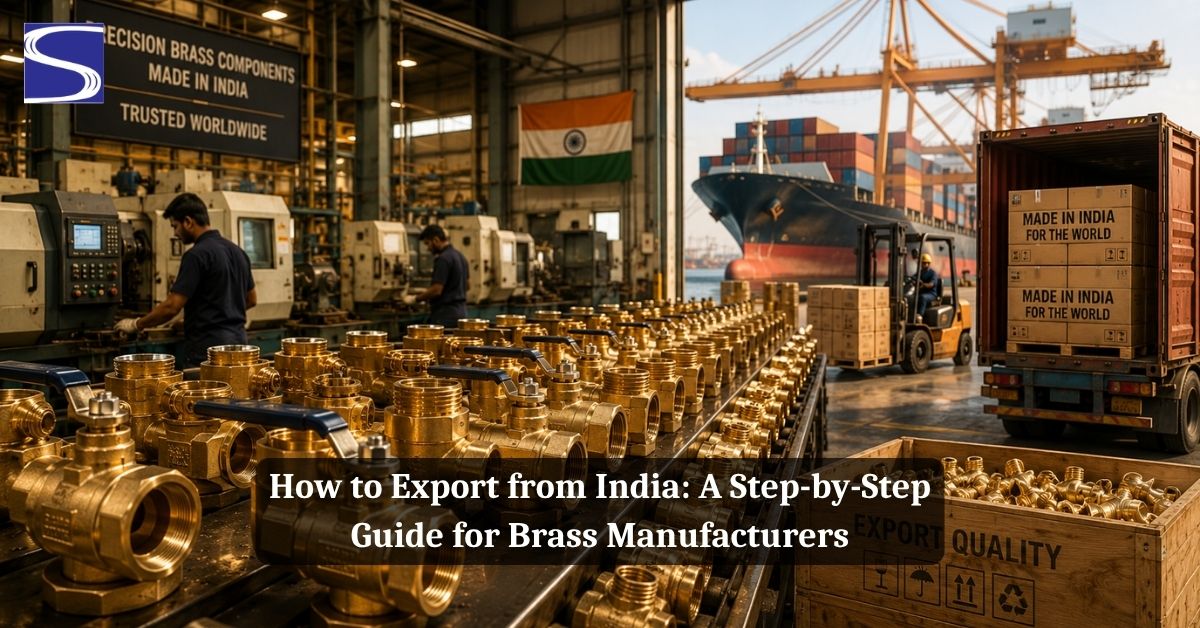
New exporters to international trade are frequently daunted by what the process involves. There are a lot of moving parts from the registrations to the documentation to identify potential buyers.
This article teaches brass product manufacturers the stepwise process of exporting from India. It simplifies how to export from India so that the brass product manufacturers can initiate exports and foster buyer relations at a global scale.
Why Brass Manufacturers Should Consider Exporting
Brass component production is one of the most competitive manufacturing markets across the globe, with India being one of the dominant countries and Jamnagar, Gujarat known as India’s “Brass City.” The demand for Brass export from India to markets in the USA, Europe, and the Middle East and, as a result, the growth of brass component exports have significantly increased over the past 10 years.
Manufacturers of brass fasteners, fittings, and electrical components can significantly increase their profit margins and business opportunities by exporting, thereby minimizing the risk of demand fluctuations. Many of the smaller and medium-sized brass manufacturers in Jamnagar have been able to increase their revenues by 3-4 times just by adding a couple of export markets to their businesses in addition to the domestic market.
Step 1: Understand the Basics of How to Export from India
Before shipping your first container, you need to understand the regulatory framework. How to export from India starts with a few mandatory registrations that every manufacturer must complete.
Register Your Business
- Obtain an Import Export Code (IEC) from the DGFT.
- Register for GST to remain tax compliant and claim input credits.
- Obtain RCMC (Registration Cum Membership Certificate) from the respective Export Promotion Council.
- Open a Current Account with the bank authorized to deal in foreign exchange.
- Register for the applicable schemes for export incentives, if applicable.
Choose Your HS Code
Every product must have an appropriate HS (Harmonized System) code. In the case of brass products, this decides your duty structure, export incentives, and how customs will classify your products at the ports.
HS codes can be complicated. It is easy to classify an HS code incorrectly and cause significant delays to your shipment. You should definitely consult a customs broker to be sure.
Step 2: Learn How to Export Products from India Efficiently
After all the registrations have been completed, setting up the process for exporting goods is the next step.
How to export products from India smoothly depends on three things: quality control, proper packaging, and reliable logistics partners.
Quality Control Practices
- Each batch should be tested against international standards (ASTM, DIN, etc.) or other specifications agreed upon by the buyer.
- Be sure to document the material certifications for every lot.
- Have a third-party agency perform the inspections.
Packaging for Export
During the export process, brass components may become damaged if they are not packaged correctly. Consider using moisture-resistant packaging and a box designed for ocean transport.
A Jamnagar exporter sending brass valves to Europe uses separate poly-wrapping with dividers manufactured from corrugated cardboard to avoid surface damage caused by vibrations in transit. The cost of the extra packaging is typically much less than the cost associated with rejected shipments or damage claims.
Step 3: Understanding the Process Behind Brass Production
If a potential buyer is thinking about ordering in bulk, they typically want to know more about the manufacturing process. By learning the process behind brass production from the initial stages of sourcing raw materials and then progressing through the steps of casting, machining, plating, and finishing, you will be able to provide the information that helps you close the deal.
Offering the details of your manufacturing process in your catalog or on your website, as well as in the factory video calls, helps build confidence in the new clients who cannot visit the factory. Some exporters have created short videos that provide a walkthrough of the manufacturing process.
Step 4: How to Find Buyers for Export from India
This is the largest hurdle for most manufacturers. Knowing how to find buyers for export from India requires a deep understanding of the multiple strategies that are needed for both the online and offline worlds, rather than the use of a single method.
Online Channels
- On platforms like Alibaba, TradeIndia, or IndiaMART, list your business.
- Include all your product offerings, relevant certifications, and an overview of your factory on your business website.
- Use LinkedIn to engage with sourcing personnel and purchasing managers directly.
Offline Channels
- Participate in international trade fairs like the Jamnagar Brass Fair or other foreign hardware fairs.
- Work with export promotion councils to host buyer-seller meetings.
- Utilize the services of trade agents or consultants that focus on your required market.
There is no guaranteed shortcut to learning how to find buyers for export from India. As a general guide, from the time you begin outreach, you can expect it to take a few months before you begin to receive orders. During this time, be patient and remember that serious buyers often ask a lot of questions.
Many Brass Parts Exporters in Jamnagar have found that the best way to establish long-term connections and business partnerships is to participate in trade fairs regularly instead of relying solely on online listings.
Step 5: How to Export from India to USA
Brass products made in India can enter the USA in large quantities because it is a huge market. The following tips can help you with how to export from India to USA once you are ready to send your first shipment.
- Keep brass products compliant with US customs and any related anti-dumping duty requirements.
- Use a freight forwarder with specific expertise related to shipments to the US.
- Get to know your Incoterms (particularly FOB, CIF, DDP) to know where your cost and risk are.
- Be mindful of the risk of longer transit times and adjust inventory levels accordingly.
Documentation Checklist for USA-Bound Shipments
- Commercial invoice
- Packing list
- Bill of lading
- Certificate of origin
- Material test certificates
Understanding Payment Terms and Pricing for Export Orders
pricing. New exporters tend to underprice orders to get a buyer, but this impacts negatively on margins for future orders.
- Always include freight, insurance, and currency conversion costs.
- Letters of Credit (LC) and advance payments are secure payment methods.
- Consider a partial advance payment with the remaining balance due at shipment for established buyers.
- Whenever possible, especially for large first time buyers, review the buyer’s payment history.
Up front pricing and payment terms to allow for proper cash flow planning and to avoid the risk of disputes over payment.
Step 6: How to Export Brass Products Successfully
The key to success in export brass products is to meet buyers’ expectations. Customer satisfaction is based on quality and consistency. Standardize quality control for all production runs.
- Standardize quality checks for all production runs.
- Maintain open communication with buyers on lead times and delays.
- Provide a few sample shipments prior to bulk order requests.
- Create a basic system to track repeat buyer requirements.
Common Mistakes to Avoid When Exporting
- Overlooking buyer-specific requests for packaging and labeling.
- Insufficient time for shipping, customs and documentation.
- Failing to review the legality of the international contracts and payment terms.
- Not checking the credibility of buyers before shipping large-volume orders.
- Offering initial orders at unsustainably low pricing.
Conclusion
Brass Product Export from India can be a profitable business although the rules and regulations may be tedious. From registrations to quality checks to finding the right buyers, each process is a step towards establishing your business successfully internationally.
Manufacturers who slow down and learn how to export from India properly, rather than rushing through the process, tend to make fewer costly mistakes and retain buyers better. The right approach can connect brass exporters from Jamnagar and all over India to markets like the USA and beyond.
Frequently Asked Questions
You will need IEC code, GST registration, RCMC certificate, and product-specific certifications.
Normally 4-8 weeks, depending on production schedules, customs clearance and shipping method.
Major importers of Indian brass components are USA, Germany, UK and UAE.
Yes, Along with the IEC code and guidelines of the export promotion council for your product category.
Use verified B2B platforms, trade fairs and work with export consultants who check the buyers’ credibility.