
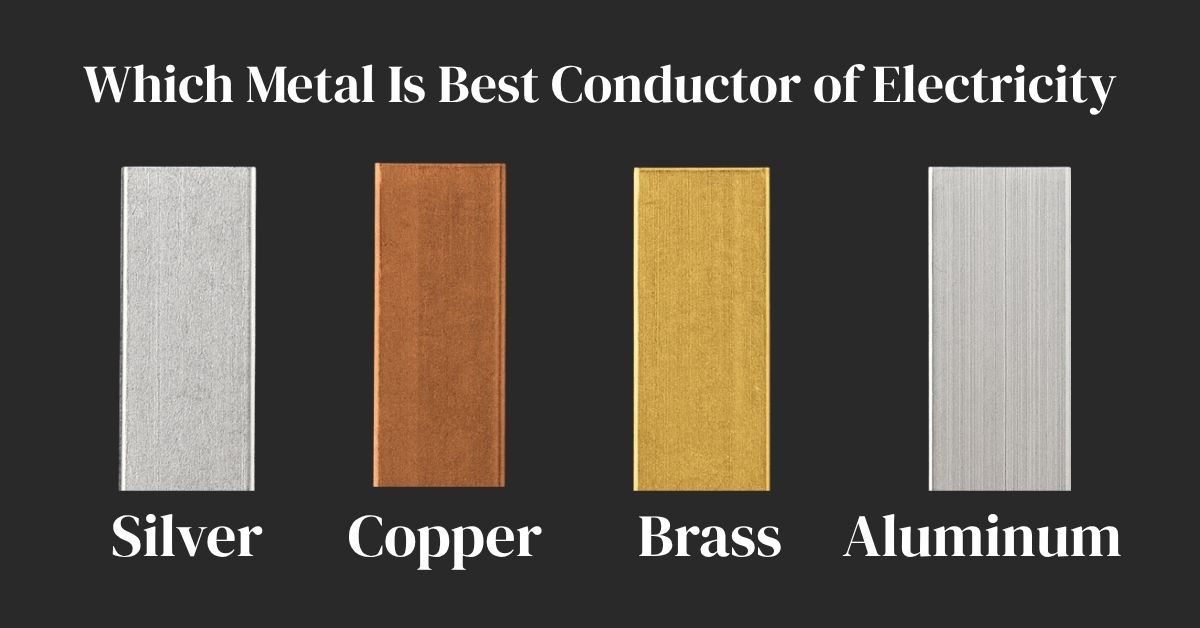
Electricity runs our lives—from kitchen appliances to factories and high-tech devices. But when industries select materials for wiring, terminals, and electrical fittings, the real question isn’t just which metal is best conductor of electricity in theory—it’s which one performs best for the job at hand. At Saryu Industries, we manufacture brass electrical components used across India’s electrical and industrial sectors, so we see this trade-off between conductivity, cost, and durability every day.
We’ll break down how metals conduct electricity, see which ones rank highest, and show you where brass fits into real-world industrial applications.
What Is an Electrical Conductor? (Conductor Meaning, Explained)
Search for conductor meaning in electricity and most explanations bury the answer in jargon. Here’s the short version: what is a conductor of electricity, in plain terms? It’s a material that lets electric current pass through it with very little resistance, because its outer electrons move freely between atoms instead of staying locked to one nucleus. Copper wire, an aluminum bus bar, the brass pin in a wall socket — all conductors, all for the same underlying reason.
So what is a good conductor of electricity, exactly? It comes down to resistance. A good conductor offers very little opposition to current flow, which is why metals dominate the category — their atomic structure leaves electrons loosely attached and free to drift when a voltage is applied. Materials on the other end of the scale, rubber, glass, ceramic, dry wood, hold their electrons tightly and block current almost entirely. That’s what makes them insulators instead, and it’s why you’ll find rubber coating the outside of a wire and copper doing the actual work inside it.
People phrase it different ways, “what is good conductor of electricity,” “what makes something a good conductor,” but the answer stays the same: low resistance, free-moving electrons, minimal energy lost as heat.
A few quick distinctions worth knowing:
- Conductors: low resistance, electrons move freely. Copper, silver, aluminum, brass, gold.
- Insulators: high resistance, electrons stay put. Rubber, glass, plastic, ceramic.
- Semiconductors: in between, and switchable. Silicon and germanium, the backbone of every transistor.
Silver is generally accepted as the best electrical conductor among metals, a claim covered in detail further down this guide, with copper as the practical runner-up for almost everything actually built at scale. So, what is the best conductor of electricity in day-to-day terms? Among common metals, that’s silver on paper and copper in practice, though as you’ll see below, “best” depends heavily on what you’re building.
Why Are Metals Good Conductors of Electricity?
This unique behavior is exactly why metals are good conductors of electricity, and it’s also the reason engineers often ask: which metal is best conductor of electricity for a particular job. From copper wires in your walls to silver-plated connectors in high-end electronics, the choice of metal matters greatly.
Because of this quality, engineers and electricians prefer metals for everything from wires and circuit boards to heavy-duty connectors and electric motors. Understanding which material is the best conductor of electricity is essential for selecting components used in electrical and industrial applications. Silver is widely recognized as the best conductor of electricity metal, offering exceptional conductivity and efficient energy transfer.
For high-performance applications that require durable and precisely engineered metal parts, explore our range of premium-quality Brass Electrical Parts, crafted for reliable electrical and industrial use.
Top Conductive Metals Ranked by Electrical Performance
Next, let’s look at the metals that carry electricity best and see how they stack up.
1. Silver - The Highest Conductor of Electricity
When it comes to conductivity, silver sits at the top. It is scientifically proven to be the highest conductor of electricity among all metals. Silver allows electrons to move more freely than any other element, which means less energy is lost as heat.
But silver is expensive, and it tarnishes, which is why it’s not used in most everyday electrical items or big projects.Still, if you ask which metal is best conductor of electricity, silver technically wins the race.
2. Copper - The Industry Favorite
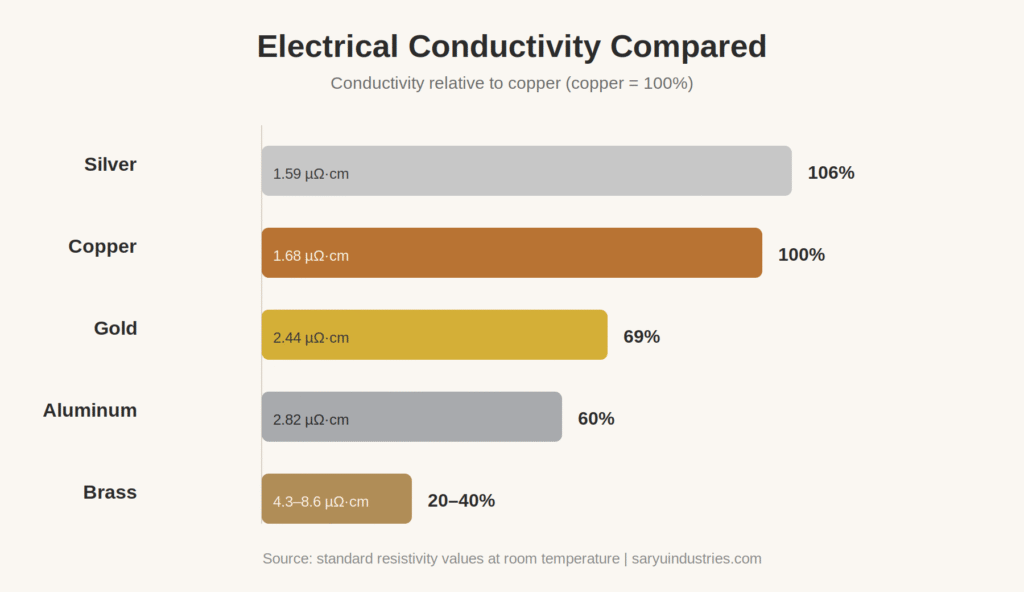
Is copper good conductor of electricity? You bet it is. Copper is almost as useful as silver but much cheaper. That’s why it’s the metal of choice for home and commercial wiring. At 1.68 × 10⁻⁸ ohm-meters, copper’s resistivity sits only about 6% above silver’s, which is a small enough gap that copper wins on cost every time.
Copper strikes a wonderful balance between price and performance, and you’ll find it in:
- Electrical wiring
- Power generation plants
- Electronics
- Solar and wind systems
Copper’s world doesn’t stop there. When metal is mixed with other elements, it still shines. The copper-zinc mix called brass is also a decent conductor. Curious about where brass fits in? Refer to the Uses of Brass Metal for the details.
3. Gold - The Reliable Performer
Gold isn’t the highest conductor of electricity, but it has a superpower: it never rusts. Its resistivity runs higher than copper’s, at 2.44 × 10⁻⁸ ohm-meters, so it loses on raw conductivity. That’s why you see it in premium electronics, including the tiny connectors inside our smartphones, the circuits in satellites, and the precision components where everything has to last. Gold gives you peace of mind that conductivity won’t drop over time.
4. Aluminum - Lightweight and Widely Used
Aluminum won’t win any awards for conductivity, its resistivity is 2.82 × 10⁻⁸ ohm-meters, nearly double copper’s, but it’s light and cheap, which is a big win in many designs. You’ll find it in:
- Power lines that stretch over the countryside
- Aircraft wings are where every ounce counts.
- Heat sinks that cool computer chips
While not the best conductor, it offers a fantastic trade-off in specific applications. Aluminum is roughly a third the weight of copper for the same volume, so on a long transmission line the weight savings outrun the conductivity loss. Still, in large projects, people often ask: which metal is best conductor of electricity when weight, cost, and efficiency must be balanced, and aluminum often ranks as a strong contender.
5. Brass - A Balanced Choice
Brass is a conductive metal that balances mechanical strength and moderate conductivity. Depending on the zinc content, brass typically runs 20-40% IACS (the industry scale that rates copper at 100%), which explains why it never tops a pure conductivity chart. It’s used in terminal pins, grounding systems, and electrical fittings. While not as conductive as silver or copper, its durability and machinability make it valuable in various industrial applications, especially for components like brass bolts and brass terminals.
Are you interested in learning more about the role of brass in the Indian industry? Read this insightful post about the Brass City of India – home to a significant hub for manufacturing brass components.
Electrical Resistivity of Common Metals: Quick Comparison Table
Numbers settle the debate faster than adjectives do. Here’s how the main contenders actually compare, measured in ohm-meters at room temperature, lower means better conductor:
Metal | Resistivity (Ω·m) | Conductivity vs. Copper | Typical Use |
Silver | 1.59 × 10⁻⁸ | ~106% | High-frequency electronics, RF connectors |
Copper | 1.68 × 10⁻⁸ | 100% (baseline) | Wiring, motors, transformers |
Gold | 2.44 × 10⁻⁸ | ~69% | Corrosion-proof connectors, aerospace |
Aluminum | 2.82 × 10⁻⁸ | ~60% | Transmission lines, aircraft wiring |
Brass | ~4.2-8.4 × 10⁻⁸* | 20-40% IACS | Terminal pins, fittings, fasteners |
Brass resistivity varies with zinc content and alloy grade, which is why it’s given as a range rather than a single figure.
The takeaway most engineers land on: silver wins the spec sheet, copper wins the budget, and brass wins the parts that actually have to survive being handled, threaded, and left outdoors.
Need Brass Components for Electrical Applications?
While silver and copper top the conductivity charts, brass remains the preferred choice where mechanical strength, corrosion resistance, and machinability matter as much as conductivity. That’s why brass dominates in terminal pins, cable glands, fuse contacts, and ceiling rose fittings across the electrical industry.
Saryu Industries manufactures precision brass electrical parts from our facility in Jamnagar—India’s brass manufacturing hub. Explore our range of Brass Electrical Parts or request our catalogue for technical specifications.
Which Metal Conduct Electricity Best? Application-Based Guide
The answer to which metal conduct electricity best depends on how and where the metal is being used:
- Electronics & Semiconductors: Gold and silver handle tiny currents beautifully, but silver wins on raw conductivity.
- Wiring & Infrastructure: Copper balances cost and efficiency, making it the go-to for buildings and systems.
- High-Voltage Transmission: Lightweight aluminum steps in for long-distance lines where weight matters.
- Affordable Fittings & Connectors: Brass, a copper-zinc alloy, stands proud where cost and corrosion resistance are key.
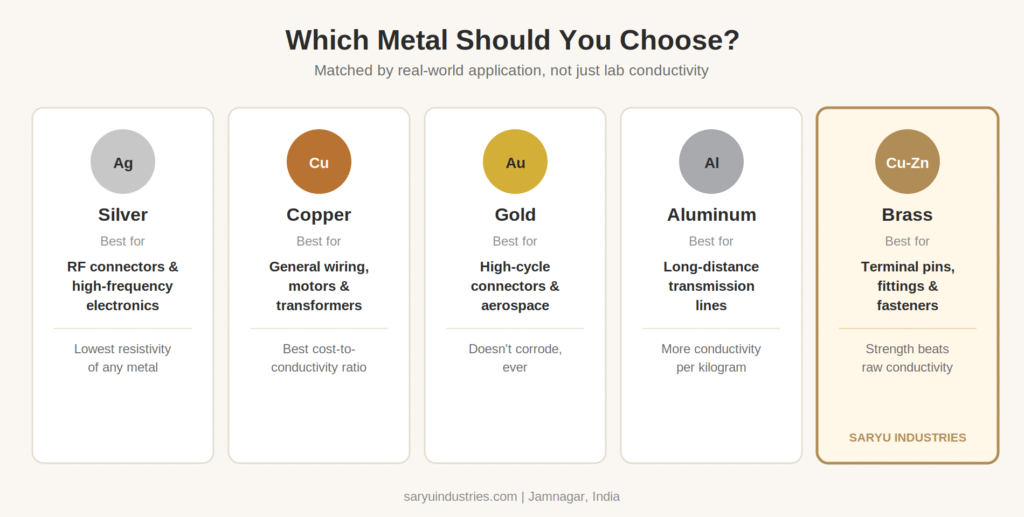
Application | Best metal | Why it wins here |
High-frequency electronics, RF connectors | Silver | Lowest resistivity available |
General wiring, motors, transformers | Copper | Best cost-to-conductivity ratio |
Long-distance transmission lines | Aluminum | More conductivity per kilogram than copper |
High-cycle connectors, aerospace | Gold | Doesn’t corrode over decades of use |
Terminal pins, fittings, fasteners | Brass | Mechanical strength plus moderate conductivity |
Each of these conductor metals serves a specific role depending on conductivity needs, budget, and corrosion resistance. Metals conduct electricity efficiently because they contain free electrons, which explains why metals are good conductors of electricity. Silver is known as the best conductor of electricity metal used in various electrical applications.
Factors That Affect Electrical Conductivity in Metals
Not all metals are created equal, and a few factors can significantly influence their conductivity:
- Purity Level: The cleaner the metal, the better it conducts. Tiny impurities can mess things up.
- Temperature: Cooler temps usually mean better conductivity because atoms get less jittery.
- Geometry: The size, shape, and thickness of the wire or piece can either speed up or slow down the current.
Even the metal conductive properties may shift depending on environmental conditions.
Is copper good conductor of electricity?
Absolutely. Copper still rules for day-in, day-out applications. Its combo of high conductivity, decent availability, and a wallet-friendly price keeps it at the top.
So when you wonder, “Is copper good conductor of electricity?” The answer is a loud, confident yes. It’s so entrenched that any metal-like aluminum that tries to take the crown faces a copper-comparison test on efficiency and cost.
Copper still leads the industry in:
- Commercial and residential wiring
- Motors and transformers
- Telecommunications
- Power generation and distribution
Fun Fact: The Role of Brass in Electrical Systems
Brass isn’t the top conductor, but its blend of copper and zinc gives it unique advantages. It’s tough, doesn’t corrode easily, and works well under mechanical stress. This makes brass the go-to choice for switchgear, terminal connectors, and even some eye-catching decorative fittings.
Jamnagar, called the Brass City of India, is a powerhouse for brass parts. Visit a Brass Components Manufacturer in Jamnagar to dive into its markets and learn where these pieces are used.
Frequently Asked Questions
Silver, copper, and gold, in that order. Silver has the lowest resistivity, copper is a close second at a fraction of the cost, and gold trails both but never corrodes.
None hit exactly 100% since copper itself is the 100% baseline on the IACS scale. Silver comes closest, at roughly 106% of copper’s conductivity.
Silver, by a clear margin. Gold’s resistivity is about 54% higher than silver’s. Gold gets chosen anyway in places where corrosion resistance matters more than raw conductivity.
Silver, copper, gold, aluminum, and brass, ranked by pure conductivity. Rank them by real-world use instead and copper and brass jump ahead, since cost and durability decide most purchase orders.
Moderately. It conducts less than copper but holds up better under mechanical stress and corrosion, which matters more in terminal pins and fittings than lab-grade conductivity does.
A material that lets electric current flow through it easily because its electrons move freely between atoms. Metals, saltwater, and the human body all conduct; rubber and glass don’t.
Any material with low resistance to current flow. Metals qualify because their outer electrons aren’t tightly bound to individual atoms, so they drift under an applied voltage instead of staying put.
Silver, technically. It has the lowest electrical resistivity of any metal, which is what “best conductor” means in practical terms.
Conclusion: Which Metal Is Best Conductor of Electricity?
So, which metal is best conductor of electricity?
- Silver has the highest conductivity, but its high price keeps it out of most everyday applications.
- Copper offers the optimal combination of conductivity, cost, and ease of availability.
- Gold, aluminum, and brass all have critical spots where they shine.
For most projects, copper delivers the best balance of efficiency and cost. If you need top-notch conductivity or resistance to corrosion, then silver or gold are worth considering. And if the part needs to survive real-world handling more than it needs a perfect resistivity score, that’s exactly where products like brass cable glands earn their spot.