
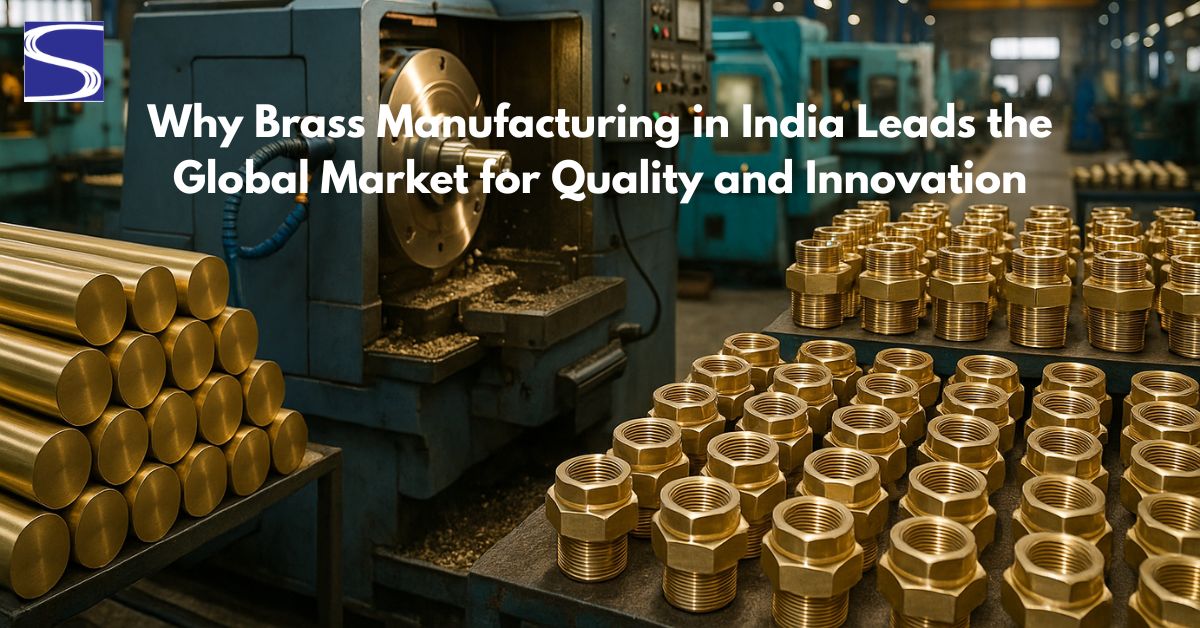
As long as anyone can remember, India has been casting brass for intricate pieces and pieces that can even be used for electrical fittings. The quality and innovation consistently seen in brass manufacturing in India are praised worldwide. The demand for brass is directly met with a blend of advanced machinery and highly skilled workers.
This is made possible due to a blend of skilled workers, state-of-the-art equipment, and an ever growing network of brass parts suppliers catering to the global demand.
India’s Brass Industry: Strength, Scale, and Global Reach
India has managed to hold a strong dominance over the market due to the strong strength and scale foundation of the brass industry. The city of Jamnagar in Gujarat, has a strong hold over the brass industry in India. It is a cornerstone in India’s rapidly growing metal sector.
If you want to witness the modern manufacturing and immersive export activities, you can do it in the brass industries Jamnagar. It is a well known industrial center in India. It is also replete with thousands of small and medium enterprises that provide fittings, pins, and other terminal components. Jamnagar has also been well recognized for its quality and reliability.
Brass products from India are applicable in almost every industrial field such as plumbing, automotive, electronics, and marine engineering, due to their strength, conductivity, and corrosion resistant properties.
The Evolution of Brass Production in India
The growth of brass production in India embodies its relentless modernization pursuit, as every region in India is producing brass. Previously, the industry operated on manual casting and turning systems. Now, the use of CNC and precision machining technologies have dissuaded inaccuracy and waste.
Most manufacturers have a strong emphasis on the following:
- Efficient systems for green melting and recycling
- CNC machining for precise components
- Innovative product designing through CAD systems
- Quality enforcement in accordance to ISO and ASTM
These developments have allowed the brass manufacturing in India to achieve and even surpass the expected performance and quality set internationally.
Innovation in Brass Casting Techniques
One of the key pillars in India’s Global leadership is their acquisition of brass casting in India. Manufacturers use a variety of steel casting systems: sand casting, pressure die casting, and gravity die casting, according to the customer’s needs.
Each of these systems offers its own special advantages from the production of electronic light components to industrial strength fittings. The continuous growth of molding technology, along with the additive and subtractive of alloy systems, ensures superior strength, conductivity, and corrosion resistance.
Additional modern casting facilities focus on energy savings, waste management, and lowered carbon footprints, and thus connect with world sustainability objectives.
Why Global Buyers Choose Indian Brass Parts Suppliers
Indian brass parts suppliers have developed a reputation for worship reliability, and as a result, buyers have come to prefer India. These suppliers balance skill and low pricing to ensure buyers across the globe get full value for their money.
In Indian brass suppliers, you will find an embedded value proposition that is hard to find elsewhere.
- Provides tailored solutions to angling specific industrial needs.
- Assured delivery and sustained quality.
- Sound export compliance with strong and reliable infrastructure.
- Material that is weatherproof and rustproof.
India has a reputation, largely thanks to manufacturers like Brass Pin supplier as a leader in the design and production of both electric and mechanical components.
Technological Advancements Fueling Growth
Technology has transformed the brass manufacturing in India, allowing for faster and more accurate production. Efficiency has increased terribly due to the use of 3D designs, robotic assembly, and automated quality checks, which has also significantly plummeted errors.
Maxim benefit as enabled by CNC machines, which is elaborated in this feature on Precision-Machined Components, have ever more modernized the standards of accuracy along with productivity.
Through constant innovation, Indian manufacturers have been able to maintain leadership positions in the global exports of metal components and simultaneously cater to the growing new requirements of various sectors like, renewable energy, construction, and the automotive industry.
Brass vs. Stainless Steel - Why Brass Holds Its Edge
Brass is more versatile and easier to machine unlike stainless steel which is another metal that is commonly used. When comparing Brass vs. Stainless Steel, in the context of plumbing and electrical uses, brass is more cost effective due to its superior corrosion resistance.
Brass is composed of a copper and zinc alloy which permits the designing of components of various degrees of hardness, colors, and durability. The availability of brass in India provides a dominant position in the brass supply chain for both the Indian market and international markets.
Sustainability and Eco-Friendly Practices in Brass Production
The focus of the modern brass industry in India does not only lie with profits, but also includes the environmental impact. Brass is 100% recyclable and Indian manufacturers have taken steps to minimize emissions and waste.
The steps that have been taken focus on:
- Induction melting with the use of metal scrap
- Energy efficient furnaces for casting
- Zero-liquid discharge systems in plating units
The green initiatives strengthen the position of India on the global exports market while providing for the Indian industry.
Government Support and Global Expansion Opportunities
Making headway towards economic growth and expansion through initiatives such as ‘Make in India’ and export-promotion policies, the Government of India has been vital in easing the growth of the nation’s economy. Small scale manufacturers of brass in the industry garner assistance in trade participation, training, and in the technology upgrade process.
Brass manufacturing in India is set for continuous growth with the international demand for brass on the rise. India possesses the following strategic advantages:
- Lower costs of production relative to the Western countries’ markets.
- High level of technical skills and innovative capabilities.
- Geographic position favorable for easy export logistics.
Strengthening presence in Europe, North America and the Middle East markets, manufacturers of brass in India are facing increasing demand from international markets.
Future of Brass Manufacturing in India
Brass manufacturing and brass production in India is set to be in the spotlight with advancements in automation, smart manufacturing and digital design. The foreseeable future is bound to experience the integration of AI-driven systems and IoT enabled machines to keep a feedback loop for real time quality control.
Manufacturers are also looking at brass casting in India with specialty engineering lightweight composite and alloys. There is a high demand for materials that are high in performance, and sustainable as a manufactured material, brass is still a favorable candidate for its light weight, strength and conductivity properties.
Conclusion
Brass manufacturing in India is synonymous with quality, low prices, and new ideas. Because of decades of experience combined with modern-day technologies and a focus on eco-friendliness, Indian manufacturers continue to raise the international standards of metalworking.
Each and every brass industry player, starting from part suppliers to precision component exporters, is part of a legacy of reliability and trust. India is much more than a manufacturing center – With its recent improvements in brass casting and increased international recognition, India is the very center of the world brass revolution!